A mislabeled spray bottle, a missing Safety Data Sheet, or disinfectant used at the wrong dilution can create a problem long before an OSHA inspection. The compliance questions cleaning chemicals raise are practical purchasing and training issues for facility managers – especially in Miami-Dade and Broward County, where heat, humidity, and high-touch common areas increase cleaning demands.
I regularly see facilities buy a chemical that appears suitable, then discover the team lacks the dispenser, dilution control, PPE, label process, or documented procedure to use it properly. Compliance is not a matter of keeping more chemicals in the closet. It is selecting products your staff can use safely, consistently, and according to the manufacturer’s directions.
Start With the Hazard Communication Standard
For most commercial facilities, OSHA’s Hazard Communication Standard is the foundation for chemical compliance. If employees may be exposed to hazardous cleaning products during normal work, they need information about those products, access to Safety Data Sheets (SDS), appropriate labeling, and training that they can understand and apply.
This applies to concentrated floor cleaners, disinfectants, restroom chemicals, degreasers, glass cleaners, odor-control products, and many other products used by custodial teams. A product does not need to look dangerous to require attention. Even a familiar cleaner may carry handling instructions, personal protective equipment recommendations, first-aid information, and storage limitations.
The practical question is not simply, “Do we have SDS sheets?” Ask whether an employee working an evening shift in Doral, Hialeah, or Fort Lauderdale can find the current SDS quickly and identify what to do after a splash, spill, or incorrect mixture. A binder in a locked purchasing office is not much help during an active incident.
Keep SDS Access Current and Useful
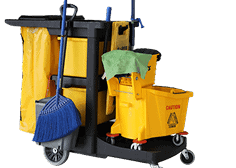
Maintain an SDS for every hazardous chemical currently in use or stored onsite. Remove outdated sheets when a product is discontinued, and replace them when a supplier provides an updated version. Your chemical inventory should match what is actually in janitorial closets, maintenance rooms, loading areas, and mobile cleaning carts.
For larger properties, I recommend assigning responsibility to a specific manager rather than assuming the task belongs to “the cleaning department.” Building service contractors, warehouse supervisors, and property managers should also agree on who maintains documentation when more than one employer works at the site.
Cleaning Chemical Compliance Questions to Ask Before Buying
The right compliance questions cleaning chemicals require should be asked before a purchase order is issued, not after cases have arrived. A lower per-gallon cost can disappear quickly if the product requires equipment you do not have, creates avoidable training needs, or is too concentrated for the staff who will use it.
Start with the surface and the task. A neutral floor cleaner for routine maintenance is not interchangeable with a restroom disinfectant. A disinfectant should be selected based on the surfaces being treated and the claims on its label. If a product is being used for disinfection, the label’s contact time matters. Spraying and immediately wiping a surface dry may not deliver the result the product is designed to provide.
Then consider how the product will be dispensed. Ready-to-use chemicals can reduce mixing errors in small offices, medical and dental offices, or sites with limited trained staff. Concentrates can be more efficient for large warehouse, school, and multi-building operations, but only when paired with correct dilution equipment and clear procedures. Neither format is automatically better. The best fit depends on labor, storage, usage volume, and the level of control your operation can maintain.
Ask these questions during product selection:
- Is the product intended for the specific surface, soil load, and cleaning or disinfecting task?
- What dilution ratio, contact time, ventilation, and PPE does the manufacturer require?
- Does the site have compatible bottles, labels, dilution equipment, and storage space?
- Can supervisors train every employee who will handle the product, including temporary or overnight staff?
- Is the product’s SDS available and included in the facility’s written Hazard Communication process?
Secondary Containers Are a Common Weak Point
Many compliance issues begin when a chemical is transferred from its original container to a spray bottle, mop bucket, or smaller dispenser. The original manufacturer label may be complete, but the secondary container becomes anonymous once the chemical is poured.
A secondary container generally needs a workplace label that identifies the product and communicates its hazards. The exact approach can vary based on how the container is used, including limited situations where an employee uses it immediately during the same shift. Still, relying on exceptions is a poor operating habit. In a busy Broward County office tower or Miramar warehouse, bottles get set down, passed between employees, and left for the next shift.
Use durable labels that identify the chemical clearly. “Blue cleaner” or “bathroom spray” is not adequate. The label should correspond to the SDS and make it easy for employees to recognize the product. Replace labels that fade, peel, or become unreadable from moisture. South Florida humidity is hard on paper labels, particularly in exterior maintenance closets and loading areas.
Never use beverage containers for chemicals. It creates an obvious exposure risk and makes it harder to maintain a controlled, professional chemical program.
Storage, Ventilation, and Incompatible Products
Chemical storage is where facility conditions matter. Heat can degrade products, increase pressure in containers, and make a poorly ventilated closet unpleasant or unsafe for staff. In Miami, Coral Gables, Hollywood, and throughout South Florida, closets near exterior walls or mechanical rooms can become significantly hotter than the rest of the building.
Keep chemicals in their original containers whenever possible, with lids secured and labels visible. Store them away from direct heat, floor drains where a spill could travel, and areas vulnerable to water intrusion during hurricane season. Shelving should be stable enough to prevent containers from falling, and heavier cases should be placed lower to reduce lifting and spill hazards.
Do not store products together merely because they are all labeled “cleaners.” Some chemicals can react dangerously when mixed. Bleach-based products and acids are a familiar example, but employees should never be asked to rely on memory alone. Follow the manufacturer’s storage guidance, train staff never to mix products unless the label specifically directs it, and maintain a spill response procedure appropriate to the materials onsite.
Ventilation requirements deserve the same attention. A strong restroom chemical may be appropriate for a well-ventilated commercial restroom but unsuitable for a tight utility closet or enclosed area with limited airflow. Product fit includes the building environment, not just cleaning performance.
Training Must Match the Products on Site
A generic annual safety presentation does not replace chemical-specific training. Employees should understand the products they use, the hazards they may encounter, where SDS information is stored, the PPE required, and what to do in an emergency. Training should happen when a new chemical or new hazard is introduced, not only after something goes wrong.
Keep instructions simple and close to the task. For example, a crew using a disinfectant should know the dilution method, whether gloves or eye protection are required, the necessary contact time, and whether the space needs ventilation. A warehouse team using a degreaser needs different guidance from an office attendant maintaining restrooms.
For multilingual teams, training must be presented in a language and vocabulary employees can understand. In South Florida, that frequently means planning beyond a one-page English handout. Demonstration, posted instructions, and supervisor follow-up often prevent more errors than a signature sheet alone.
Victor Feria can help facility teams match commercial cleaning chemicals with compatible dispensers, labels, PPE, and routine-use procedures. The goal is not to turn managers into chemical experts. It is to make daily cleaning safer, clearer, and easier to supervise.
Review Your Program Before Hurricane Season
Hurricane season adds a separate chemical-control challenge. Emergency cleanup can lead teams to bring in unfamiliar products, use more disinfectant than usual, or move supplies into temporary storage locations. Water intrusion, mold concerns, and power interruptions can also change how chemicals are stored and accessed.
Before severe weather is approaching, review your inventory, confirm containers are sealed, elevate supplies where flooding is possible, and verify that SDS records remain accessible if an office or server is unavailable. If cleanup contractors will be working onsite, coordinate responsibilities for chemical use, labeling, PPE, and spill response before work begins.
A simple pre-season review is usually less disruptive than sorting through damaged cases and unidentified bottles after a storm.
Frequently Asked Questions
Do all cleaning chemicals need an SDS?
Hazardous chemicals used in the workplace generally require an SDS to be available to employees. Review each product’s manufacturer information rather than guessing based on the product’s appearance or purpose.
Can employees mix cleaners to make them stronger?
No. Employees should never mix cleaning chemicals unless the manufacturer’s label specifically directs it. Mixing products can create dangerous fumes, reduce effectiveness, or damage surfaces and equipment.
Do ready-to-use disinfectants eliminate compliance responsibilities?
No. Ready-to-use products can reduce dilution errors, but facilities still need correct labeling, SDS access, training, PPE when required, and adherence to the product label’s contact-time instructions.
How often should a facility review chemical labels and SDS records?
Review them whenever products change and as part of a regular facility safety check. A quarterly review is practical for many Miami-Dade and Broward County operations with active cleaning programs.
A well-run chemical program should make the right action easier than the wrong one: clear product choices, readable labels, available SDS records, and training that works under real shift conditions. Call (786) 919-0195 or email victor@victorferia.com to schedule a free facility supply review.
Need help choosing the right supplies?
VICTOR FERIA helps Miami-Dade and Broward businesses choose the right janitorial, paper, hygiene, chemical, disinfectant, glove, and safety products.
Request a Free Supply ReviewRelated resources for Miami-Dade and Broward businesses
Facility Supply FAQ
What is included in a Free Supply Review?
A review of current products, usage, waste, safety needs, reorder issues, and product-fit recommendations.
Do you serve both Miami-Dade and Broward?
Yes. VICTOR FERIA serves businesses across Miami-Dade and Broward with janitorial, paper, hygiene, chemical, glove, and safety supply recommendations.
Can you help choose paper products, disinfectants, gloves, or safety supplies?
Yes. Recommendations are based on the facility, task, traffic level, staff needs, and budget.
How do I ask for help?
Use the Free Supply Review button or contact VICTOR FERIA through the Contact Us page.